
Media
HKUMed finds no increased risk of autism or ADHD in children from prenatal paracetamol use
02 Jul 2026
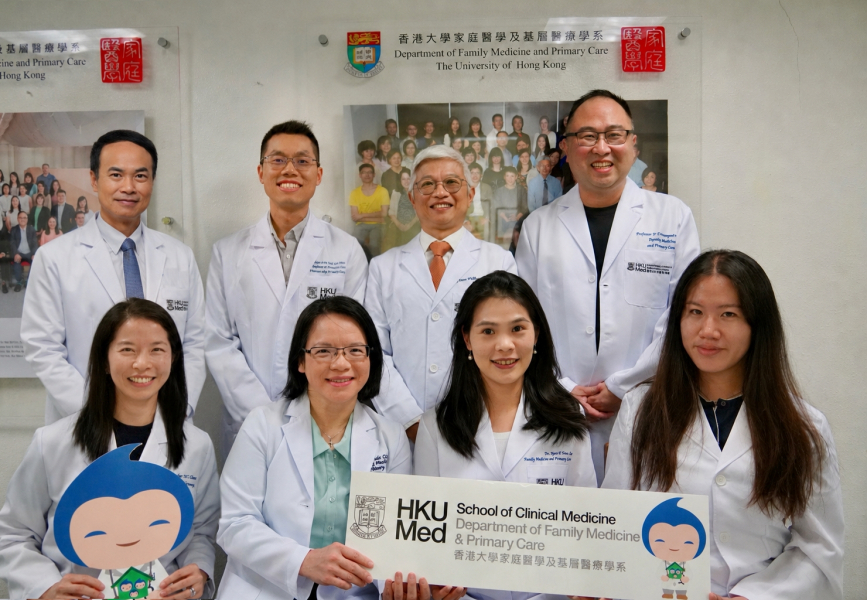
HKUMed research team finds no increased risk of autism or ADHD in children from
prenatal paracetamol use. The research team members include (back row, from left) Professor Ian Wong Chi-kei, Professor Eric Wan Yuk-fai, Professor William Wong Chi-wai, Professor Peter Tanuseputro, and (front row, from left) Professor Esther Chan Wai-yin, Professor Linda Chan, Dr April Luo Shan and Qiaowa Gong.
Researchers from the LKS Faculty of Medicine at the University of Hong Kong (HKUMed) have found that using a commonly used pain killer (paracetamol or acetaminophen) during pregnancy does not increase the risk of autism spectrum disorder (ASD) or attention‑deficit/ hyperactivity disorder (ADHD) in children. This represents the first study in Hong Kong to apply a rigorous sibling-matched approach to compare siblings from the same mother to effectively account for shared genetic and environmental influences. The findings, published in JAMA Internal Medicine [link to the publication], offer timely reassurance for expectant mothers and clinicians in Hong Kong and globally regarding the safety of paracetamol use during pregnancy.
Addressing global anxiety: the paracetamol debate
Paracetamol is the most widely used medication for pain and fever during pregnancy. However, concerns about its potential association with ASD and ADHD have intensified following overseas reports and policy discussions. While international health authorities, including the World Health Organization and the Department of Health in Hong Kong, have reaffirmed its safety profile, robust local evidence was previously lacking – a gap that this study has now filled.
Sibling-matched analysis accounts for shared familial factors
Some previous studies suggested a modest increase in ASD and ADHD risk in offspring but did not fully account for differences between mothers who did and did not use paracetamol, such as underlying health status, lifestyle or familial factors. To address these methodological limitations, the HKUMed team analysed electronic medical records from 708,020 mother–child pairs in Hong Kong between 2000 and 2023, allowing a more comprehensive and accurate assessment.
Initial analyses without sibling matching reproduced earlier findings of a slight increase in risk. However, when the researchers applied a sibling-matched design—comparing siblings exposed and unexposed to paracetamol during mothers’ pregnancy—no association was observed between prenatal paracetamol exposure and the risk of ASD or ADHD in their offspring. These findings remained consistent regardless of dosage, timing of exposure (across all trimesters), and pattern of use (sporadic, intermittent or persistent).
Robust evidence supports paracetamol’s safety during pregnancy
Dr April Luo Shan, Research Assistant Professor in the Department of Family Medicine and Primary Care, School of Clinical Medicine, HKUMed, said: ‘I had herpes zoster during my pregnancy, but I did not take paracetamol at that time because of concerns raised in the media. As both a researcher and a mother, I deeply understand the anxiety many women face. Our study provides the reassurance I wish I had and would have helped me manage the pain I was experiencing.’
Professor Peter Tanuseputro, Clinical Professor in the same department, added, ‘Previous conflicting studies generated doubt and unnecessary stress for expectant parents, leading many mothers to endure untreated pain or resort to other medications that may be less safe. Our sibling-matched study within a massive Chinese cohort provides robust evidence that paracetamol is safe during pregnancy.’
Professor Ian Wong Chi-kei, Professor in the Department of Pharmacology and Pharmacy, HKUMed, added. ‘Monitoring the long-term outcomes of children with in-utero drug exposure requires an incredibly robust data infrastructure. Thanks to the Laboratory of Data Discovery for Health (D24H) at AIR@InnoHK, the Research Grants Council and Hospital Authority, we were able to rapidly address this urgent drug safety question with the necessary precision and scale.’
About the research team
The study was led by Professor Eric Wan Yuk-fai and Professor Peter Tanuseputro, both from the Department of Family Medicine and Primary Care, School of Clinical Medicine, HKUMed, together with Professor Ian Wong Chi Kei Wong, Professor, Department of Pharmacology and Pharmacy, HKUMed. The first author is Dr April Luo Shan, Research Assistant Professor, School of Clinical Medicine, Department of Family Medicine and Primary Care, HKUMed.
Acknowledgments
The data collection was funded mainly by the General Research Fund of the Research Grants Council of the Government of the HKSAR. Additional support was provided by the D24H under AIR@InnoHK, established by the Innovation and Technology Commission of the Government of the HKSAR.
Media enquiries
Please contact LKS Faculty of Medicine of the University of Hong Kong by email (medmedia@hku.hk).
 Facebook
  HKU IOS App
  HKU Android App
  Social Media and Apps